Nonprofit Jargon is a Sure Way to Drive Off Donors
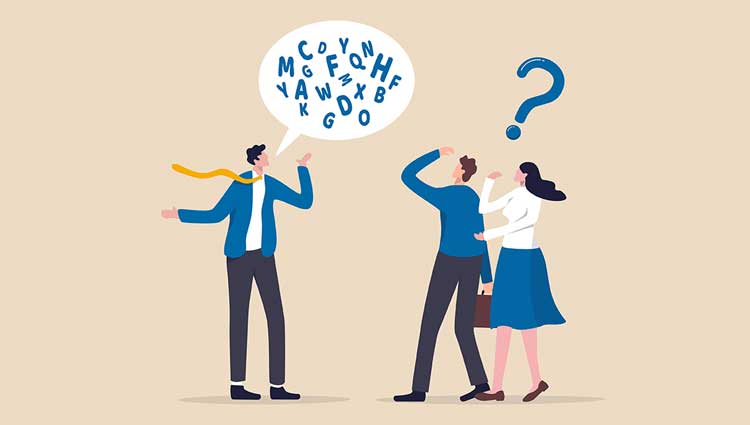
One of biggest challenges to marketing nonprofit gifts lies in the language we, as an industry, use.
On one hand, there’s a tendency toward technical details and board (bored)-speak when describing gift vehicles. The typical fundraiser reasoning is, “We’re writing for an educated audience.”
On the other hand is the tendency to use jargon—the kind of industry language that only nonprofit insiders truly understand.
Not coincidentally, the reasoning behind both approaches is the same. And so is the result: an unengaged audience.
Nonprofit Jargon to Lose and Better Words to Use
Here are six examples of jargon to eliminate from your nonprofit’s vocabulary—along with far more effective language you can use instead.
“Now more than ever”
(Thanks to Debbie Eliason, senior director of Planned Gifts at WETA TV, WETA Classical and PBS NewsHour.)
This phrase is so overused it’s lost any power it once had. Instead, be genuine and direct:
“We need your gift today, because (our program is at risk of shutting down; we’ve struggling to keep the lights on; families can’t feed their children,” etc.).
“Impact, Impactful”
(Thanks to Cathy R. Sheffield, chief advancement officer at Lena Pope.)
“Impact is an ugly word. … I hear the word ‘impact’ and think of a collision,” Cathy says.
I couldn’t agree more—I cringe every time I see it in an appeal. While “impact” can be used as a noun or verb, and it can mean “to make an impression,” the first dictionary definition carries a negative connotation. From Merriam-Webster.Com:
1) a: an impinging or striking especially of one body against another
b: forceful contact or onset
In context, that could be, “The collision’s impact left a dent in the driver’s-side door.” Or “The impact of the tragedy was felt by the entire community.”
Unfortunately, this nonprofit jargon is deeply embedded in fundraising language. It has been misused for so long it’s probably too late to put the cat back in the bag. But the next time you write an appeal or a thank-you, consider properly using the noun “effect” instead:
“The effects of your donation will be felt for generations to come!”
Even better, be specific and state what the gift will do:
- “Your generous endowment will fund scholarships for generations to come.”
- “Your donation will help our animal shelter supply food and medicine for three senior dogs for six months.”
- “Your gift will help us to provide two weekend meals to a hungry child for an entire school year.”
And please, absolutely avoid using “impactful.” It’s a real word, but at best sounds disingenuous. Instead, use a more specific and descriptive adjective: generous, transformational, inspirational, life-changing … you get the idea.
“Over-the-transom gift”
(Thanks to consultant Jeff Comfort, former vice president, Principal Gifts and Gift Planning, Oregon State)
This term for realized bequests that a nonprofit wasn’t aware of should make you cringe. “Over the transom” originally referred to unsolicited (and unwelcome!) manuscripts sent to publishers—the phrase implied that the manuscripts were thrown over the transom of a door, after business hours. “When I’ve heard this phrase, I ask if we should thank surviving loved ones for the lovely ‘over the transom’ gift,” Jeff says. “So disrespectful.”
Instead, just call it what it is: “A surprise gift.” “An unexpected bequest.” Or even, “A pleasant surprise!”
“Making a difference”
This is a lazy phrase. Of course you’re trying to make a difference. But donors want details—how are you making a difference? How will their donation be used?
Once again, specificity wins the day:
“Your gift will help us find homes for rescued dogs and cats.” “You gift will help us to spread God’s word to future generations.” “Your donation will help us to build a new pediatrics wing.”
"Donor”
(Thanks to Nate Broeckert, executive director of Coal Creek Meals on Wheels)
Yup, I said it, I’ve been saying it for years, and Nate agrees. Donor-centric language is the key to engaging your supporters—and the word “donor” is about as impersonal as you can get. When you think of your nonprofit as a business, your donors are really your customers. And just like any nonprofit, “We are doing everything in our power to have repeat customers; to have repeat donors,” Nate says. “So it’s really just thinking about the customer experience when it comes to donors … the biggest language shift has been referring to them not as donors but as partners”
When you shift to a word like “partner,” you are automatically elevating that customer experience. You are making that donor feel like they belong; like they’re a crucial part of your organization. You’re showing them that they have a stake in your mission’s success.
Other words to consider:
- Supporter
- Patron
- Ally
- Angel
- Friend
A writer’s toolbox is made up of words. And like a mechanic, choosing the right tool for the job is essential. You wouldn’t use a hammer when you need a wrench. Elevate your nonprofit’s appeals, donor stories, and communications by focusing on simple, inclusive language. It’s the most direct path to effective, engaging and donor-centric fundraising.
Do you have a nonprofit jargon pet peeve? A better word for “donor” or any of the other examples above? Drop me a line, or let me know in the comments.
Let’s get one thing straight: donors are not cryptographers. Yet, nonprofits seem determined to test their decoding skills with jargon so dense it could double as an escape room puzzle. I have experienced this several times.
If you’re still telling supporters their “over-the-transom bequest” is “making an impact now more than ever,” congratulations—you’ve successfully made them question whether they just donated to a worthy cause or fell into a corporate buzzword abyss. Spoiler alert: they’re confused, and confused people don’t give.
Here’s a novel idea: say what you mean. If a gift is unexpected, call it that. If donations help “feed hungry children,” don’t obscure it with “supporting youth food security initiatives.” And for the love of clarity, drop “impactful.” It sounds like something a marketing intern invented to sound … well, impactful.
Fundraising is not a vocabulary contest. It’s about connecting with real people who care. So unless your mission is to bewilder donors into submission, lose the jargon. Trust me—your “supporters” (see what I did there?) will thank you.
Now go forth, be clear, and raise some real money.
(If you insist on keeping “impactful” in your lexicon, at least have the decency to donate a thesaurus.)
~ Viken Mikaelian