
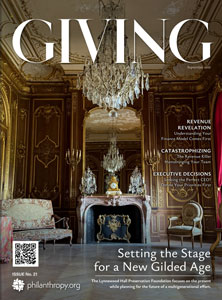
GIVING Magazine publishes twelve covers a year. Three are Special Editions.
A Special Edition is a reported feature that runs in the magazine and then stays. It receives a permanent address on Philanthropy.org, indexed and linked to your Form 990 profile on the same platform, and you can update it for as long as your organization exists.
The issue has a month. The feature does not expire.
A cover story examines an organization, a leader, or a fundraising program. A Special Edition begins with something larger, a story that would merit attention beyond the fundraising profession itself. An institution, an estate, a lineage, a piece of American history held in trust by a nonprofit board.
Most covers are not Special Editions. That is the point of the designation.
There is no application, no form, and no deadline. Three Special Editions are selected each year by the editor.
What earns consideration is the story, not the size of the organization. The question is whether the story belongs in front of the sector, and whether the organization is prepared to be seen. Not all are. That is a legitimate answer.
A Special Edition is reported, not submitted. Our editor-in-chief, Patrick O’Donnell, conducts the interviews, including interviews with board members. The organization supplies photography; we direct it and build the design around the story rather than fitting it to a template.
We also pitch the story to appropriate national and trade publications on the organization’s behalf, working alongside its own communications staff. That means a written pitch, a media list built for the story, and follow-up. It does not mean a retained PR campaign, and we do not guarantee pickup. No one can. Editors decide what runs, and any publication promising otherwise is selling something other than editorial.
Production schedule: approximately 4 months.
Philanthropy.org is where the sector’s financial data lives. Donors, foundation officers, prospect researchers, estate attorneys, and reporters arrive at your numbers. The Special Edition determines what is sitting beside them.
Your feature receives a permanent address on the platform, indexed and linked to your enhanced Form 990 profile. It is the one place where your financials and your story appear together on a domain you do not own.
That last part is the whole point. A story about your institution carries weight in proportion to who published it. This is why organizations reprint third-party coverage and not their own press releases, and why the same words on your own website are worth less than they are here.
The page stays current. Boards change, campaigns close, buildings open. Send us the update and we make it.
Print mechanicals are made available to the featured organization under our imprint, for distribution to its own donor file.
This is the working end of a Special Edition. A donor who receives a reported feature from a magazine reads it. A donor who receives a printout from your own website does not. The mechanicals go into board packets, major gift solicitations, planned giving proposals, foundation applications, and donor mailings, under a masthead that is not yours.
One hundred complimentary copies of the issue are included. Additional copies and reprints are ordered separately, at cost.
The feature runs in print and lives permanently on Philanthropy.org, which draws over 100,000 visitors a month. Readership is professional fundraisers, donors, foundation staff, and researchers. Print circulation is limited and targeted rather than broad.
Every nonprofit on Philanthropy.org has a profile built from its Form 990. That is free and always will be.
An Enhanced profile lets an organization answer for itself: mission, leadership, programs, priorities. $300 a year.
A Special Edition is the third tier, and it is the only one an organization cannot write. It is reported by our editor, published in GIVING, and kept permanently on the platform. Three a year.
Special Edition subjects are selected editorially. The designation cannot be purchased or applied for.
Once selected, an organization commits $18,000 to underwrite the expanded reporting, design, production, and publicity program described above. The money does not buy editorial control, favorable coverage, or guaranteed outside placement. It is required for the Special Edition to proceed.
The Enhanced profile is included for the first year. After that it continues at the standard $300 a year, the same as any organization on the platform.
A retained PR program runs $45,000 a year and produces clips that age out of relevance in a season. This is once, and what it produces does not expire.
Half is due at commitment, half at press. Necessary travel or on-site photo direction is billed at cost.
If the number is the obstacle, say so early. We would rather have that conversation in the first week than the third month.
Advertising in GIVING is available and described in full on its own page, as is sponsorship on 990 Scout. Neither has ever influenced editorial selection, and neither ever will. Keeping advertising and editorial separate is a dull policy that produces the only thing worth having: readers who believe what they read.
If a story might belong in a Special Edition, the editor can be reached through this site. With three slots a year, the answer has to be no most of the time, and we give it plainly and quickly.
GIVING Magazine is published by Philanthropy.org, part of the PlannedGiving.com family of properties. Serious thinking for serious fundraisers, since 2007.
$18,000, one time
Enhanced profile included year one
$300 a year thereafter