Attendance Is Not Governance
Many board members approve a Form 990 they never read and overlook the largest gifts their organization will ever receive.
Here is what you are actually responsible for.
Accepting a nonprofit board seat makes you a fiduciary, whether or not anyone told you so. State law expects you to protect the organization’s assets, its mission and its future. Many board members treat the role as an honor and expect to attend meetings, buy a gala table and sign off on what staff present. That’s not governance, it’s attendance.
This guide covers what nonprofit board fiduciary duties really require: financial oversight and the Form 990, your role in major gifts, the planned giving blind spot that costs organizations millions, and how to oversee an endowment responsibly. It’s written for new and experienced board members alike.
New to the Board? Start Here
In your first 90 days:
- Read the bylaws, the articles of incorporation and the last year of board minutes.
- Read the last three Form 990s. Start with How to Read a Form 990, then read What Trustees Don’t Know About Form 990 Can Hurt the Organization by Robert C. Clothier (LinkedIn, view all posts), a governance consultant for nonprofits, former Vice President and General Counsel of Ursinus College and a longtime independent school trustee.
- Sign the conflict of interest policy, and read it before you sign it.
- Ask for the budget, the audit, the most recent financial statements, the investment policy and the gift acceptance policy.
- Make your own gift. The board should give 100 percent, at whatever level each member can. Clothier explains why in Give, Get, Govern.
- Ask one question at every meeting: “How are we building future revenue, not just this year’s?”
What Are the Fiduciary Duties of a Nonprofit Board Member?
Nonprofit board members have three core fiduciary duties: the duty of care, the duty of loyalty and the duty of obedience. Together they require board members to make informed decisions, put the organization’s interests ahead of their own, and keep the organization faithful to its mission and the law. Care and loyalty are firmly established in state nonprofit law. Obedience is recognized by courts and in many states, including New York.
Duty of Care: Read Before You Approve
The duty of care means acting in good faith, with the diligence a reasonably prudent person would use in the same position. You don’t have to be an accountant, but you do have to pay attention.
Start with the basics. Review current financial statements and cash flow at every meeting, not just the annual audit. Make sure internal controls exist so no single person can move money unchecked. Hire, evaluate and set the pay of the chief executive. The board doesn’t run the organization, but it is responsible for making sure someone competent does.
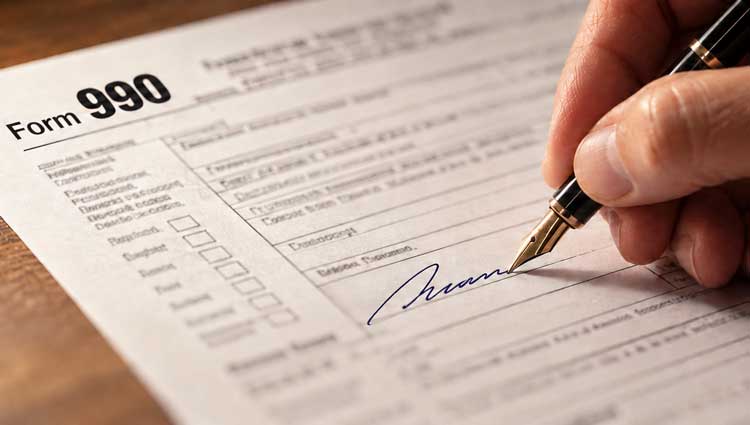
The IRS asks whether you were given the chance to pay attention. Part VI of the Form 990 asks whether a copy of the return was given to the governing body before it was filed, and asks the organization to describe the board’s review process. Receiving the return isn’t the same as reading it, but the answer is public, and donors, journalists and foundations read it.
The 990 is the organization’s public report card, and your name is on it in Part VII. Learn the Financial Health Signals and study the Red Flags and What They Mean. You can look up any organization’s filing, including your own, with the free 990 Lookup.
As Clothier warns in his Form 990 guide for trustees, a board that signs off on the 990 without understanding it is taking risks it doesn’t see.
Does anyone actually enforce these duties? We examine who holds boards accountable, and how often, in Nonprofit Board Liability: Who Enforces the Rules.
Duty of Loyalty: The Mission Comes First
The duty of loyalty requires you to put the organization’s interests ahead of your own. In practice, that means disclosing conflicts of interest, abstaining from votes where you benefit, and keeping board matters confidential.
The Form 990 asks whether the organization has a written conflict of interest policy, whether board members disclose conflicts every year, and whether the policy is monitored and enforced. The IRS can also impose excise taxes on board members who knowingly approve excess benefit transactions, such as overpaying an insider. If your board answers “yes” on paper but not in practice, that’s a governance failure waiting to become a headline.
Clothier, who spent nearly twenty years on the board of The Haverford School, puts it plainly: a conflict of interest policy only protects the organization if trustees actually live by it.
Duty of Obedience: Stay True to the Mission
The duty of obedience requires the board to keep the organization faithful to its stated mission, its governing documents and the law. It includes honoring donor restrictions. When a donor gives money for a specific purpose, the board must make sure it is used that way. Misusing a restricted gift can violate the law, and it ends future giving.
Paperwork matters too. A charity’s own errors can cost a donor their entire tax deduction, as estate planning attorney Vanessa M. Terzian shows in Good Intentions, Bad Paperwork: How Charities Sabotage the Gifts They Receive.
The Board’s Role in Fundraising
Fundraising is a board responsibility, not just a staff function. The classic expectation is “give, get or get off.” A more useful version is give, open doors and stay engaged. As Clothier argues in Give, Get, Govern, fundraising starts with how you govern.
Give. Foundations and major donors routinely ask whether the board gives at 100 percent. If the board doesn’t believe in the organization enough to give, outsiders won’t either.
Open doors. Your network matters more than your check. Board members get meetings that staff can’t.
Thank donors. A call from a board member tells a donor their gift was noticed at the top of the organization.
Major Gifts: Where Board Members Make the Difference
Major gifts come from relationships, and relationships at that level are often peer to peer. A business owner listens to another business owner. A retired executive returns a call from another retired executive.
Strong boards review the major gift pipeline at least twice a year: who the top 25 prospects are, who owns each relationship, and which board member can help. Weak boards never see the list.
Planned Giving: The Fiduciary Blind Spot
A development director once told us about a woman who was turned away at the door of their gala because of how she was dressed. Only afterward did the organization learn she was a multimillionaire. The donors who leave the largest gifts often don’t look the part, and many never attend a gala at all.
This is where most boards fail without knowing it. No law requires a planned giving program. Good stewardship does.
Cerulli Associates projects that roughly $124 trillion will pass between generations through 2048, with an estimated $18 trillion going to charity. In our experience, much of what reaches charities will move through wills, trusts, retirement accounts and beneficiary designations, not checks. Your organization’s largest future gifts are being decided right now, in lawyers’ offices and in retirement plan paperwork.
A board that only reviews this year’s annual fund is ignoring the largest asset its organization may ever receive. Every board should be able to answer these questions:
- Do we have an active planned giving program, or only a “remember us in your will” line on the website?
- Do we have a gift acceptance policy covering bequests, real estate, life insurance, stock and retirement assets?
- Do our gift acknowledgment letters meet IRS requirements?
- Do we know how many donors have already named us in their plans?
- Do we have a legacy society that recognizes them?
- Has every board member considered including the organization in their own estate plan?
The gift acceptance question isn’t theoretical. A woman once walked into a nonprofit and asked whether it accepted real estate. The staff were away at a retreat, and the administrative assistant told her, “I really don’t think we take such things.” The property was worth $20 million, and it was donated elsewhere. A board-approved gift acceptance policy, and a front desk that knew it existed, would have put that offer in front of someone who could evaluate it.
The last question on the list matters too. A board that has made legacy commitments itself can ask others with credibility.
Endowment Oversight and UPMIFA
If your organization has an endowment, the board is responsible for it. In 49 states and the District of Columbia, endowment management is governed by the Uniform Prudent Management of Institutional Funds Act (UPMIFA). Pennsylvania follows its own statute. UPMIFA requires the board to manage and invest institutional funds prudently, considering factors such as general economic conditions, inflation, the organization’s other resources and its long-term purposes.
At minimum, the board should approve and regularly review:
- A written investment policy statement covering objectives, risk tolerance and asset allocation
- A spending policy that balances current needs against preserving purchasing power for future generations
- A process for monitoring investment performance and fees
An Investment Perspective
Most boards inherit an investment policy and never revisit it. A board that hasn’t reviewed its investment and spending policies in three years isn’t overseeing its endowment. It’s hoping. Review all three at least annually, and again whenever a major bequest changes the size of the fund.
Questions about endowment oversight or investment policy? We’re glad to talk.
An endowment is the clearest expression of a board’s duty to the future. See how today’s gifts grow over decades with the free Endowment Calculator.
Donor-Advised Funds: Know Where the Money Comes From
A growing share of major gifts now comes through donor-advised funds. If your board doesn’t understand DAFs, it doesn’t understand where its donors’ charitable dollars are held. Start with the Donor-Advised Funds resource center we built on Philanthropy.org.
Board Checklist
12 Questions Every Nonprofit Board Should Ask This Year
Print it, bring it to your next board meeting and don’t adjourn until every question has an answer.
- 1Did every board member review the Form 990 before it was filed?
- 2Do we see current financial statements and cash flow at every meeting?
- 3Is our conflict of interest policy signed, current and enforced?
- 4Does every board member give?
- 5Who are our top 25 major gift prospects, and who owns each relationship?
- 6Do we have a planned giving program with a dedicated budget?
- 7Do we have a current gift acceptance policy, and does our front desk know it exists?
- 8Do we have a written investment policy statement?
- 9Is our endowment spending policy sustainable?
- 10Are we honoring every donor restriction?
- 11What do our peers’ 990s show compared with ours?
- 12Have we invited donors to tell us about their legacy plans, and made it easy for them to do so?
For Experienced Board Members: Leave a Legacy, Not Just a Term
Board terms end, but the organization goes on. The most valuable thing a veteran board member can do is build the structures that outlast them: a funded endowment, a planned giving program and a legacy society full of names. Your term on the board is temporary. What you build during it can last for generations.
Is Your Organization Ready for the Wealth Transfer?
Start with your own Form 990. Claim your free nonprofit profile on Philanthropy.org, then bring the 12 questions above to your next board meeting. To see what a working planned giving program looks like, visit PlannedGiving.com.
Frequently Asked Questions
What Are the Three Fiduciary Duties of a Nonprofit Board?
The duty of care, the duty of loyalty and the duty of obedience. They require informed decision-making, putting the organization’s interests first, and staying faithful to the mission and the law.
Can Nonprofit Board Members Be Held Personally Liable?
Rarely, but it happens. Courts generally protect good-faith decisions under the business judgment rule, and the federal Volunteer Protection Act protects unpaid board members against many negligence claims. That protection is conditional. It doesn’t cover gross negligence or willful misconduct, it doesn’t stop the nonprofit itself from suing a board member, and much depends on state law and the facts of the case. The real exposure comes from self-dealing, ignoring obvious problems and, in some cases, unpaid payroll taxes. Indemnification and directors and officers insurance add protection. As a former general counsel, Clothier has seen how quickly good intentions turn into legal exposure when boards stop paying attention. For how often these rules are actually enforced, see Nonprofit Board Liability: Who Enforces the Rules.
Who Enforces Nonprofit Board Duties?
State attorneys general are the primary enforcers. The IRS can penalize board members who knowingly approve excess benefit transactions, and in some states members or fellow directors can bring suit. We examine enforcement in practice in Nonprofit Board Liability: Who Enforces the Rules.
Are Board Members Required to Donate?
The law doesn’t require it, but many foundations and major donors expect 100 percent board participation. As Clothier argues in Give, Get, Govern, the expectation should be made clear before a trustee ever joins the board, not after.
Does the Board Have to Review the Form 990?
The IRS doesn’t require board review, but Form 990 asks publicly whether the board received a copy before filing and how it was reviewed. Good governance means yes.
What Is the Board’s Role in Planned Giving?
The law doesn’t require a planned giving program. As a matter of sound stewardship, we recommend the board make sure one exists and is funded, approve a gift acceptance policy, and monitor legacy commitments. Many boards also ask each member to consider including the organization in their own estate plan.
What Is UPMIFA?
The Uniform Prudent Management of Institutional Funds Act, adopted in 49 states and the District of Columbia, which sets standards for how nonprofit boards invest and spend endowment funds.
Further Reading
- Window of Opportunity for Nonprofits
- 990 Schedules Explained
- Prospect Research with 990s
- Benchmarking Against Peers
- What Is an Endowment? (a complete guide for board and leadership)
This article is for educational purposes only and does not constitute legal, tax or investment advice. Consult qualified professionals about your organization’s specific circumstances.