
Planned Giving: Preserving Legacies — and Lynnewood Hall — for Future Generations
COVER STORY
Ramona Ramadar, Director of Gift Planning for The Salvation Army, Greater New York Division, shares the secret(s) of the organization’s success.

COVER STORY
Ramona Ramadar, Director of Gift Planning for The Salvation Army, Greater New York Division, shares the secret(s) of the organization’s success.

The Form 990 asks what an organization spent last year. It does not ask what its leaders did before they got here. Treasury is weighing new disclosure rules for nonprofit officers. They address the wrong half of the problem — and the public record still won’t show you the difference.

Hampshire College had famous alumni, loyal donors, and over half a century of history. It still closed. Ken Burns gave $5 million. The board tried to sell land. Neither was enough. The reason traces back to 1965, when the founding gift was spent on construction instead of invested as endowment. This article examines what Hampshire got wrong — and what Olin College got right — and what every nonprofit should learn from both.

Ken Burns called Hampshire College an “incalculable” influence. That didn’t save it. When Hampshire closed, the story wasn’t enrollment or debt — it was an endowment that never grew large enough to buy time. Form 990 tells it plainly. For every nonprofit leader, trustee, and donor: mission does not replace capitalization. Reputation is not capital. Endowments are infrastructure for endurance. Hampshire’s lesson is arithmetic, not sentiment — and it applies to you.

Most nonprofits raise money, spend it, and start over. Every year. That cycle has a name: the treadmill. Endowments are the alternative — a financial structure that generates permanent, recurring support without requiring your organization to begin from zero each January. This guide covers everything nonprofit boards and executive directors need to know: what endowments are, how they work, what they cost, how to start one, and how to have the conversation with donors who are already thinking about legacy.

Planned giving is the most powerful engine of endowment growth, yet most nonprofits lack a structured strategy connecting the two. Transformational bequests — from Annenberg to a Vermont janitor — prove legacy gifts are about trust, not wealth. Strong organizations align development, investment, and governance around long-term sustainability. A 30-question self-assessment helps leaders identify gaps. When those structures are in place, donor confidence follows — and so do the gifts that fund missions for generations.
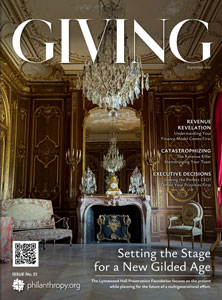
GIVING Magazine
For those who drive change — not watch it. Join the top 1%.