
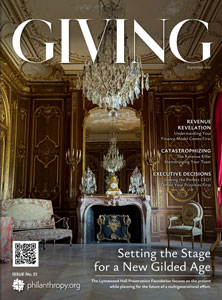
Visionary Voices

Visionary Voices is philanthropy.org’s editorial forum for serious ideas, hard-earned lessons, and informed perspectives shaping the future of philanthropy. It is a place for practitioners, leaders, and thinkers to examine what works, what doesn’t, and why.

Contributions explore strategy, governance, donor engagement, ethics, and the structural forces influencing philanthropy today. Articles are grounded in experience, analysis, and reflection—not promotion.

If you’ve developed insight through practice, research, or leadership, we welcome thoughtful submissions that advance credible dialogue and long-term thinking in the field.

Browse by Topic
Two hands reaching toward each other, meeting in warm light — the moment of human connection.

The GIVE Arc

What moves people to give isn’t a well-crafted ask. It’s everything that came before it. The GIVE Study — conducted by GOSUMEC Foundation USA — found that donors who moved through four stages of relationship: Gratitude, Impact, Voice, and Engagement, gave more, gave deeper, and brought others with them. The ask was the last step, not the first. Relationships convert. Campaigns exhaust. This is the science behind why.

Read More »
Senior nonprofit CEO contemplating long-term organizational strategy

CEOs Think Long Term. Fundraisers Think Fiscal Years.

Most planned giving programs fail not because of lack of donors — but because leadership delegates what only leadership can own. Development officers rotate between jobs every 18 months. Planned gifts take decades to mature. That mismatch quietly kills programs before they produce. The organizations that consistently realize legacy gifts share one trait: the CEO owns the program as an institutional priority, not a staff assignment.

Read More »
Ancient stone bridge over a river in the Scottish Highlands — a symbol of endurance, permanence, and long-term nonprofit sustainability through endowment giving.

What Is a Nonprofit Endowment? A Complete Guide for Boards and Leadership

Most nonprofits raise money, spend it, and start over. Every year. That cycle has a name: the treadmill. Endowments are the alternative — a financial structure that generates permanent, recurring support without requiring your organization to begin from zero each January. This guide covers everything nonprofit boards and executive directors need to know: what endowments are, how they work, what they cost, how to start one, and how to have the conversation with donors who are already thinking about legacy.

Read More »
A bird's nest with eggs resting on ancient stone columns at sunset — symbolizing endowment growth and legacy preservation.

Nonprofit Endowment Strategy: Questions CEOs Never Ask

Planned giving is the most powerful engine of endowment growth, yet most nonprofits lack a structured strategy connecting the two. Transformational bequests — from Annenberg to a Vermont janitor — prove legacy gifts are about trust, not wealth. Strong organizations align development, investment, and governance around long-term sustainability. A 30-question self-assessment helps leaders identify gaps. When those structures are in place, donor confidence follows — and so do the gifts that fund missions for generations.

Read More »
Person helping another climb mountain at sunrise representing mentorship and generosity in nonprofit leadership

What Small Nonprofits Can Learn from Faith-Based and Educational Institutions

Small nonprofits often look to large foundations for inspiration, but the real masters of sustainable giving are faith communities and schools. These institutions rely on belonging, rhythm, and visible impact—not urgency campaigns—to create stable, long-term generosity. They build identity before asking, creating trust through consistent rituals, transparency, and shared purpose. Any nonprofit, regardless of size, can adopt this emotional architecture to strengthen donor retention, deepen engagement, and cultivate a community that gives because the mission reflects who they are.

Read More »
charitable bequest donor contemplating legacy gift

How to Leave Money to a Charity in Your Will — and Why It’s One of the Most Important Decisions You’ll Ever Make

A charitable bequest — a gift made through your will — is one of the most powerful forms of generosity available to ordinary people. It costs nothing today, requires no minimum wealth, and can be changed at any time. Yet the typical bequest is 200 to 300 times larger than a donor’s biggest annual gift. This guide explains how bequests work, how to structure them, and how to choose an organization prepared to receive and steward what you leave behind.

Read More »
Man standing at a forest crossroads symbolizing reevaluation and change

Time to Move On – The Reason Relationships End

Most relationships don’t end in drama. They erode quietly as priorities shift, leadership changes, and implicit contracts expire. Longevity is not proof of alignment. Sometimes what feels like betrayal is simply evolution. The real mistake isn’t moving on—it’s pretending nothing changed while the cost of staying continues to rise.

Read More »

The Authenticity Imperative: Lessons from Bad Bunny’s Super Bowl Performance

Bad Bunny’s Super Bowl performance illustrates the power of authenticity. In health research and advocacy, honoring language, culture, and community values leads to stronger trust, better data, and improved outcomes. Studies on culturally tailored diabetes programs confirm this impact. Communities must be partners, not subjects. Funders must support inclusive, community-driven research to sustain meaningful progress.

Read More »
Faucet slowly leaking water

Your Bequest Pipeline Has a Leak You Can’t See

Donor-advised funds now hold over $251 billion in assets — and wealthy donors are increasingly routing legacy gifts through DAFs instead of direct bequests. When that happens, your organization moves from confirmed allocation to discretionary intent. You lose visibility. You lose influence. And revocations happen quietly, inside estate documents you were never invited to review. The bequest isn’t dying. It’s being restructured around you. The question is whether you’re inside that structure — or outside it.

Read More »
>