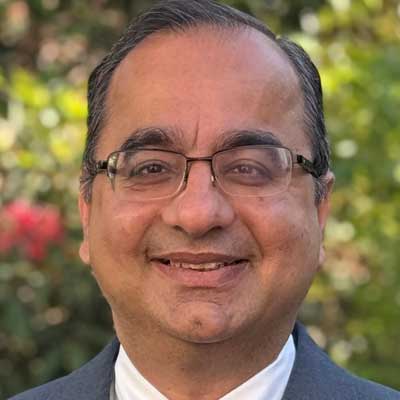
A physician walks into a fundraising conversation (and no, this is not a joke) and asks: why are we treating donor relationships like emergency room visits instead of preventive care?
Dr. Sanjay Bindra runs a zero-staff foundation. He spent a year studying what happens when you remove urgency, campaigns, and pressure from fundraising and replace them with consistency.
His findings, and the honest limits of the framework he built, are below. The contraindications section is the strongest part.
GIVE Study — GOSUMEC Foundation USA
Why Recurring Giving Is an Identity Shift, Not a Payment Plan
Behavior, Tools, and the Discipline of Consistency
By Sanjay Bindra, MD
What happens if a nonprofit removes urgency, campaigns, and pressure — and instead commits to consistent, relational engagement?
Over the past year, through the GIVE Study at GOSUMEC Foundation USA, we explored a fundamental shift in nonprofit philosophy. The results were instructive.
A majority of donors transitioned to recurring giving.
Retention among recurring donors remained exceptionally high.
Engagement evolved from episodic spikes to a steady, reliable pulse.
The conclusion was singular: tools are no longer the primary constraint. Behavior is. And consistency is the discipline that connects the two. At the center of this model is the GIVE Framework — but like any intervention, it has clear indications and real limitations.
The FrameworkWhat GIVE is — and isn't
GIVE is not a tactic; it is a behavioral operating system. It rests on the premise that recurring giving is not a payment mechanism, but an identity shift. In this system, behavior is how consistently an organization shows up; tools are the platforms that make this presence possible (now widely accessible); and consistency is the discipline that turns intent into trust.
Traditional fundraising often functions like acute care — episodic, reactive, and campaign-driven. GIVE functions more like preventive medicine — steady, relational, and designed for long-term health.
Part I — IndicationsWhere GIVE Works Best
01Retention and lifetime value
GIVE is most powerful after the first gift. Once a donor enters the system, consistent behavior builds familiarity; familiarity builds trust; and trust builds commitment. It transforms giving from a transaction into a lasting relationship.
02Small and zero-staff nonprofits
For the 92% of nonprofits operating with limited resources, GIVE is a stabilizer. Modern tools are now affordable and integrated, replacing campaign intensity with behavioral consistency. It is executable by founders, volunteers, and boards — not just specialists.
03High-trust environments
Where credibility already exists, GIVE acts as an amplifier. Storytelling becomes reinforcement rather than persuasion. Trust isn't created here — it is compounded.
04Revenue stability and compounding
GIVE shifts the internal question from "How do we raise money this month?" to "How do we build a system that sustains giving over time?" Consistency creates predictability, and predictability creates stability.
Part II — ContraindicationsWhere GIVE Falls Short
01Cold-start acquisition
GIVE is not designed for strangers. Relational giving requires familiarity, repeated exposure, and baseline trust. For first-time donors, transactional strategies — events, urgency, campaigns — still dominate. Transactional often initiates; relational sustains.
02High-urgency contexts
In a crisis, decisions are fast and emotion is immediate. Urgency is not a flaw in these moments — it is the appropriate mechanism. GIVE is not optimized for compressed decision-making.
03Founder dependency risk
Early success often depends on a founder's authentic voice and direct engagement. But systems built on individuals don't scale easily and are difficult to transfer. For GIVE to mature, it must move from being personality-driven to process-driven.
04Low-trust environments
Where trust is weak or absent, engagement can feel like marketing and storytelling can lack credibility. GIVE amplifies existing trust; it cannot manufacture it from zero.
05Behavior without structure
Consistency is not a substitute for clarity. Without clear messaging, organized data, and defined value, even the most consistent effort can fail. Behavior is the constraint — but structure is the foundation.
06Short time horizons
GIVE requires patience, repetition, and discipline. Organizations under immediate financial pressure may struggle to rely on it alone. It is a long-term system, not a short-term rescue strategy.
The Complete ModelBehavior × Tools × Consistency
The real shift is not choosing one model over another — it is understanding how three elements interact.
Modern platforms have reduced costs, all-in-one features, and simplified execution for small teams. The barrier to entry has never been lower.
Showing up consistently. Communicating clearly. Building relationships over time. This is where most organizations fall short.
The Dual-System RealitySustainable Nonprofits Run Two Systems
Campaigns · Events · Urgency · Acquisition
Purpose: Initiate the first gift
Recurring giving · Engagement cadence · Storytelling
Purpose: Sustain the relationship
For decades, the nonprofit sector optimized for the first gift. We became incredibly efficient at the handshake. But the future depends on what follows. What happens after the first gift is the real work.
ConclusionBeyond the Handshake
The GIVE Framework is not a universal solution. It is a structured response to a specific problem: low retention, episodic engagement, and unpredictable revenue. Used appropriately, it builds stability and trust. Used indiscriminately, it will fall short.
The path forward is integration: transactional strategies initiate giving, while relational systems sustain it. Between the two lies the real discipline — behavior, enabled by tools, sustained through consistency.
Transactional strategies initiate giving.
Relational systems sustain it.
Between them lies the real discipline:
behavior, enabled by tools, sustained through consistency.
The GIVE Study is the first real-time study of sustainable giving conducted through the lens of a small nonprofit. It was designed and led by a physician — not a fundraising consultant — with no financial incentives and no conflict of interest.
If you wish to learn more, all resources are publicly available:
GIVE Study: gosumec.org/givestudy
GIVE Arc Webinar: youtube.com/watch?v=gJw0Q_-xLgM
GIVE Playbook: givebutter.com/freebies/give-study
No paywalls. No courses. No consulting funnel.
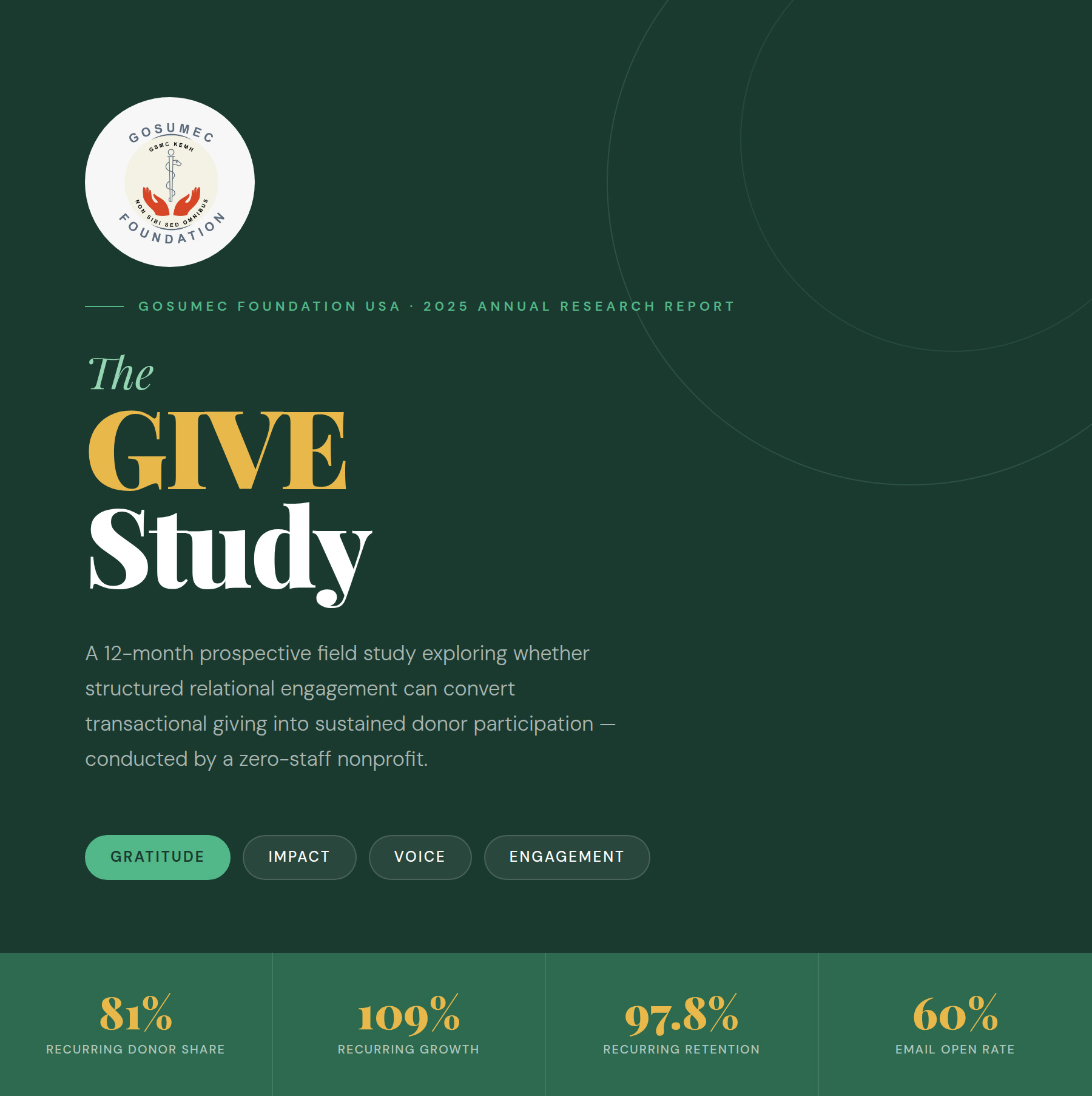
GIVE Study Brochure
Download PDF
A NOTE FROM THE EDITOR
Dr. Bindra’s framework is rigorous, evidence-based, and physician-led — and it arrives at a conclusion religious traditions reached thousands of years ago.
Tithing in Christianity. Zakat in Islam. Tzedakah in Judaism. Dāna and dasvandh in Hindu and Sikh practice. Dāna again in Buddhism. Different languages, different theologies, the same architecture: recurring, percentage-based, identity-rooted giving, practiced inside a community that meets on a cadence. Not a campaign. Not a pledge drive. A rhythm.
What Dr. Bindra calls “behavioral consistency,” the temple, church, mosque, gurdwara, and synagogue have always called practice. What he calls “the pulse,” they call the liturgical year, the weekly service, the daily prayer. What he calls “identity shift,” they call covenant, dharma, faith.
The nonprofit sector secularized over the last century and, in doing so, quietly stripped the architecture out of the act. We replaced congregation with donor base, covenant with pledge, liturgy with newsletter, and tithe with monthly recurring gift — and then wondered why retention collapsed.
Dr. Bindra has given us a modern, evidence-based framework for something the great traditions have always understood. And it works for the same reason the older systems worked: human beings give consistently when they belong to something consistently. Strip out the belonging, and the giving goes with it.
He set out to prove that small nonprofits can build sustainable recurring revenue without staff or overhead. He proved something larger: that the oldest fundraising technology on earth still works — when you remember what it actually was.
Years ago I wrote a humorous tagline for a Catholic diocese postcard:
Honk If You Love Jesus. Under the same management for over 2,000 years.
It was originally meant as a joke. But it’s also the argument. The system works. It’s been tested. And the people running it figured it out long before any of us showed up with a CRM.
Dr. Bindra is right. So were they.

Viken Mikaelian
CEO, philanthropy.org