

How Small Nonprofits Achieve Big-Institution Results
Most small nonprofits face an impossible choice: operate like amateurs and lose donor trust, or adopt governance structures they cannot afford. The sector’s conventional wisdom insists you need staff to be credible, overhead to be accountable, and scale to be professional.
A three-year case study from a medical school alumni foundation challenges these assumptions and offers a replicable model for small nonprofits seeking sustainable growth without traditional infrastructure.
The Results: Exceptional Outcomes from Minimal Resources
GOSUMEC Foundation USA, a zero-staff nonprofit supporting medical education in India, achieved metrics that significantly exceed national benchmarks:
- Over $2M in a perpetual endowment with commitments toward $3.3M
- 95%+ recurring donor retention (vs. 45% sector average)
- 80%+ recurring giving participation
- 70%+ year-over-year growth in sustaining donors
- Multiple five- and six-figure legacy commitments within two years
- Approximately 100 active donors from around 400 engaged households across 50 graduating classes
- Zero fundraising campaigns in 2025
- Under $10K per year in technology and compliance costs
These outcomes emerged from a scattered, previously unorganized alumni base with no existing chapter structure and donors dispersed nationwide, with beneficiaries in another country.
The formula: Identity-Centered Community Organizations (ICCOs)™ + behavioral architecture (GIVE) + radical transparency = sustainable generosity without traditional fundraising.
The Framework: Three Core Components
1. Identity-Centered Community Organizations (ICCOs)™
Identity-Centered Community Organizations (ICCOs) transform donor psychology by shifting supporters from transactional givers to community co-owners. When this transition occurs, giving becomes normalized rather than solicited.
Faith communities, immigrant networks, and alumni associations consistently outperform sector benchmarks because they operate as ICCOs. People give not because they are asked, but because generosity expresses their identity within the community.
Key insight: People give most generously where they feel most deeply seen.
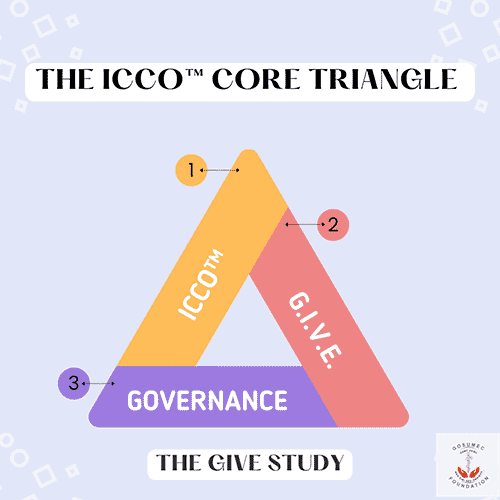
In GOSUMEC’s case, medical school alumni identity—combined with transparent governance—created conditions where supporters acted like stakeholders rather than donors.
ICCO™ — Identity-Centered Community Organization: a behavioral and relational architecture where identity, belonging, and trust drive sustainable giving.
2. The GIVE Behavioral Cycle
Traditional fundraising treats giving as a transaction. The GIVE framework creates a self-reinforcing behavioral loop:
Gratitude → Supporters feel genuinely valued
Impact → Transparent reporting demonstrates exactly where funds go
Voice → Donors shape fund allocation through directive templates
Engagement → Rituals and gatherings reinforce belonging
This cycle converts one-time donors into recurring supporters without pressure or persuasion. Stewardship becomes shared ownership rather than an organizational task.
3. Governance as Infrastructure
In the absence of staff, governance becomes the staff itself. Strong systems create predictability, safety, and confidence that enable major commitments.
Two examples illustrate this principle:
After spending an evening reviewing GOSUMEC’s governance materials online, Dr. Hasmukh Joshi committed a multi-year contribution of $100,000 the next day—without solicitation. The transparent policies, conservative investment approach, and clear reporting structure aligned with his values around ethical giving, inspired by his teacher of 55 years, Shri Pandurang Shashtri Athavale.
Similarly, Dr. Heena Thakkar, a major hospital foundation board member, signed up for a multi-year contribution of $20,000 immediately after a Zoom session detailing the organization’s governance. Her assessment: “I’ve seen major foundations with weaker governance than this.”
Neither donor needed persuasion. Governance created trust. Trust created commitment.
Framework Snapshot
For those who prefer a visual summary, here’s the core architecture behind the zero-staff model — the ICCO™ identity framework paired with the GIVE Behavioral Cycle.
ICCO™ helps small nonprofits shift from transactions → relationships → community ownership, while the GIVE Cycle makes sustainable giving predictable and replicable.
| Component | What It Means | Why It Matters |
|---|---|---|
| Identity | Donors see themselves in the mission | Creates belonging beyond transactions |
| Gratitude | Lead with acknowledgment, not requests | Builds emotional safety and trust |
| Impact | Show clear, tangible outcomes | Reinforces meaning and credibility |
| Voice | Invite participation, feedback, and agency | Shifts donors from supporters to co-owners |
| Engagement | Ongoing, relational touchpoints | Sustains giving without campaigns |
| Ownership | Community becomes stewards | Drives recurring and legacy-level commitments |
The Implementation: Discipline Without Bureaucracy
Small nonprofits can operate with institutional-grade governance at minimal cost. GOSUMEC’s infrastructure includes:
Transparency
- All policies, financials, board minutes, and donor directives are published at gosumec.org/financials
- Independent compilation reports
- Investment portfolio composition and policy statements
Accountability
- Two-person transaction controls
- Independent accounting
- Quarterly financial reviews
- Scheduled audit as accrual exceeds thresholds
Risk Management
- Conflict of Interest Policy
- Gift Acceptance Policy
- Investment Policy Statement
- Foreign Grantmaking Policy
- Endowment governance protocols
Donor Agency
- Directive templates allowing donors to shape legacy commitments within mission parameters
- Open board meetings
- Direct input mechanisms
Total annual cost: under $10,000 in technology and compliance.
The Technology Stack: Affordable Institutional Capacity
Technology replaced traditional staff functions through strategic tool selection:
- Givebutter — donor management, payment processing, multi-year commitment tracking, micro-event engagement
- MemoryFox — community storytelling
- Canva — professional communications
- Google Workspace — governance documentation and operations
- Independent accountant — financial integrity and reporting
- Website hosting — professional presence and transparency portal
This stack provides visibility and operational clarity that builds trust faster than traditional fundraising campaigns—at a fraction of staff cost.
Radical Transparency as Competitive Strategy
Large nonprofits can outspend small organizations on events and marketing. They cannot outspend them on openness.
GOSUMEC’s transparency library includes everything donors might want to see before making major commitments:
- Board meeting minutes from all sessions
- Annual financial summaries
- Investment policy and portfolio details
- All governance policies
- Donor directive templates
- Partner agreements
- Future audit plans
This radical transparency became the organization’s primary competitive advantage. It signals: nothing is hidden, every dollar is accounted for, and you can trust this.
When This Model Works Best
This approach is especially powerful for identity-rich communities:
- Alumni networks
- Faith-based organizations
- Diaspora and immigrant communities
- Professional associations
- Mutual aid organizations
GOSUMEC had specific advantages: medical school creates strong tribal identity, physicians have high financial capacity, and the founder brought governance expertise and storytelling ability.
For cause-based nonprofits (environmental groups, social services, issue-focused organizations), the principles still apply—but identity bonds must be intentionally built rather than inherited. The path is steeper, but viable.
Addressing Founder Dependence
The model’s primary vulnerability is founder dependence. Organizations can mitigate this through:
- Rotating board leadership to distribute institutional knowledge
- Documented systems, including policies, templates, and operational playbooks
- Donor rituals that build peer-to-peer bonds beyond founder relationships
- A distributed ownership culture that reduces reliance on any individual
The sustainability question is clear: Can the ICCO thrive beyond its founder? GOSUMEC is designing systems now to test whether behavioral architecture can outlast its architect.
Key Insight: Depth Over Breadth
Early findings from The GIVE Study—longitudinal research examining high-performing small nonprofits—confirm: small nonprofits do not succeed by scaling up. They succeed by deepening in.
High-performing small nonprofits are high-trust ecosystems where transparency is radical, governance is strong, volunteers are authentic, and donors feel emotionally safe.
For small organizations, trust is not an outcome—it is the operating system. Proximity, accountability, shared identity, and relational credibility become invisible infrastructure supporting the organization without bureaucracy, traditional staff, or large marketing spend.
The competitive advantage for small nonprofits is not size—it is intimacy.
Practical Implementation Steps
1. Audit Your Governance
Adopt foundational policies: Conflict of Interest, Gift Acceptance, Investment Policy Statement, and impact reporting protocols. Templates are available at gosumec.org/financials for organizations to adapt freely.
2. Implement Radical Transparency
Publish board minutes, financial summaries, and governance policies publicly. Transparency costs little and builds trust immediately.
3. Shift From Cause to Community
Use identity language, rituals, and shared gatherings to build co-ownership rather than transactional relationships. Ask: “How do we create stakeholders, not just supporters?”
4. Build the GIVE Cycle
Create feedback loops that turn one-time donors into recurring supporters through systematic gratitude, transparent impact reporting, genuine voice in allocation decisions, and meaningful engagement opportunities.
5. Invest Strategically in Systems
Identify technology tools and compliance processes (under $10K annually) that can replace higher-cost staff functions while improving operational clarity and donor confidence.
The Bottom Line
Governance is not overhead for small nonprofits—it is infrastructure. It protects donors, strengthens trust, and anchors the mission.
GOSUMEC Foundation USA demonstrates that lean nonprofits can operate with the governance quality of mature institutions without the cost or complexity. The model requires discipline, design, and transparency—not size.
The message: You do not need scale to have integrity. Good governance is the most affordable investment a small nonprofit can make.
For organizations willing to lead with transparency and build identity-centered communities, the zero-staff model offers a viable alternative to traditional growth strategies. The results suggest that when governance becomes your staff, trust becomes your capital—and depth becomes your advantage.
Access the Complete Governance Library
You can access the complete governance library, free to use, at gosumec.org/financials. The library includes all governance policies, board minutes, donor directive templates, financial summaries, independent compilation reports, and implementation guidance for small nonprofits nationwide.





This comment is from Hasmukh Joshi, MD. I have been cited in this article under “3. Governance….”
My association with Shri Pandurang Shashtri Athavale, (recipient of The Templeton Prize for Progress in Religion 1997 and founder of The Swadhyay Movement) has made me realize what it means to give with grace, considering the giving as a duty, rather than a favor to the society. It has also made me aware that the human dignity of the receiving person is to be maintained, adhering to strict standards laid down in the process of giving.
Add to this, minuscule and absolutely necessary administrative expenses and maintain transparency in reporting. Also preserve the dignity of recipients by not making public their names.
Contributors have the option of making themselves public.
The Gosumec Foundation was willing and able to incorporate all of this in the governance, which motivated me to contribute to this foundation.
Dr. Hasmukh Joshi,
Our success, as highlighted in the article, comes from one central principle: we treat our community as co-owners, not donors. By giving people a genuine voice (the V in GIVE) and inviting them into the decisions, the GOSUMEC community has shaped this work with us and not around us.
Our board and advisors are contributors just like everyone else, and we operate with shared ownership that honors the perspectives of our benefactors.
Radical transparency and ethical conduct are not add-ons—they are the foundation of our model.
At its core, the ICCO™ approach builds an identity-driven community where trust, belonging, and shared stewardship shape how we grow. It also serves as a steady guide for other small nonprofits seeking a relational path forward.
I love this formula — ICCO + GIVE behavioral design + radical transparency. It captures a real shift where people give sustainably when they feel connected, valued, and informed. Build community around identity, make giving easy and meaningful, stay transparent and generosity flows naturally, without the pressure of traditional fundraising.
Dr. Archana Bindra, as Co-Founder of GOSUMEC Foundation USA and as a major donor, you embody the shared path our community has charted, Identity through ICCO™, a behavioral approach through the GIVE Framework, and strong architecture through governance anchored in radical transparency.
Together, these principles shape a form of giving that reflects who we are. We feel like co-owners in the mission, and we are reassured that the organization honors our values and ethics. This trust, grounded in disciplined governance, is something many organizations aspire to but rarely achieve.
This is a wonderful write up on the principles that have led to the incredible success of GOSUMEC. Kudos to the founders for creating a thriving non-profit. I like the 3 major pillars: ICCO, GIVE behaviors and lean Governance. Great lessons for other non- profits here.
Thank you, Dr. Kishore Harjai, for your thoughtful comment and for your service as a board member of GOSUMEC Foundation USA.
Our hope in sharing this work is exactly what you highlighted: to offer practical, replicable lessons for small nonprofits seeking to build trust, community, and long-term sustainability without traditional staffing models.
I truly appreciate you taking the time to read and reflect. Your encouragement means a great deal.
V well organized post.
Informative and helpful thread for anyone inclined towards philanthropy.
Thank you, Dr. Shanbhag. Coming from you, this means a great deal.
You were among our earliest believers, and your example—as a cardiac surgeon and a generous mentor—has guided us from the start.
Grateful for your steady support and friendship over the years. We’ll keep building with the same discipline and purpose you’ve modeled.
Great article! Great job done by the Bindra couple.
There is never a shortage of donors. There is no other organization like GOSUMEC Foundation USA.
Thank you, Dr. Vijay Dave, for your kind comment. I’m grateful for your generosity and your steady support of the Zero-Staff Governance model we’ve shared.
Your perspective adds meaningful weight to what we are trying to demonstrate: that small nonprofits can grow through transparency, trust, and shared stewardship—not staff or scale.
At GOSUMEC, we say that sustainable giving is trust-based giving. The early results from our ongoing case study, The GIVE Study, continue to validate this, and we look forward to releasing the full findings in Q1 2026.
Sanjay Bindra and his co founder and wife have hit upon a formula that is absolutely outstanding and have put together a great community of like minded people who willingly contribute to make this Model work.
This concept and model will serve as a framework for anyone and everyone who wants to find a way to make genuine heartfelt philanthropy work with truly zero overhead other than an enduring commitment to do good and help the deserving.
Congratulations.
Thank you so much, Rohit. Your words mean a great deal to both Archana and me.
This model works because GOSUMECs believed in it, supported it, and helped shape the community that makes it possible.
We are grateful for your steady guidance on the board and for the trust you place in this mission. Together, we’ve built something that can serve as a simple, honest framework for anyone who wants to practice heartfelt, zero-staff, low-overhead philanthropy (in our case zero-overhead to donors, as we handle operational expenses and now the board.
Thank you again for your support and encouragement.
I love seeing the way GOSUMEC Foundation has pioneered a unique and meaningful approach to fundraising for zero-staff organizations! It is a joy to see you all succeed not only for your own organization, but to also see you willing to share your knowledge, learnings, and insights to benefit the whole community! Truly inspired by you both!
Thank you so much, Tiffani.
Your support has meant a lot to us from the very beginning. Givebutter has been a key part of our ability to build a zero-staff, transparent, community-driven model, and we’ve learned so much from you.
We’re grateful that our work can help others, and your encouragement always strengthens us. Thank you for being such an important partner in this journey.
Excellent article. It’s so nice to see this work being published so others can learn from this. Dr. Bindra is a powerhouse of innovation, dedication and transparency. He is a great role model of unwavering commitment to this cause. If all philanthropic organizations were run like Gosumec foundation USA, there would be so much more Philanthropy happening in the world.
Thank you so much, Dr. Alpa Sanghavi.
Your words are very kind, and I truly appreciate them. This work is only possible because of the support and trust of our GOSUMEC community and the strong values we all share.
Our goal in publishing this article was exactly what you said: to help others learn from our experience and show that small, transparent, community-driven nonprofits can create real, lasting impact.
Thank you for your encouragement and for always supporting this mission. It means a lot.
Thank you!
A clear, succinct model for nonprofit funding success!
And highly successful:
The proof is in the pudding.
These principles and practices will help all nonprofits and philanthropists in their journey to contribution and participation. Thanks Dr. Bindra!
An excellent blueprint!
Thank you so much, Sarosh. Your words mean a great deal, especially coming from someone who has helped build such a strong model at the Foundation for Excellence.
I’m glad the principles and practices resonate. Our hope is exactly what you said, that this can serve as a clear, simple blueprint for other small nonprofits and philanthropists who want to build trust, transparency, and long-term impact.
When people unite around common values or purpose, trust grows and collaboration becomes natural. As support expands, the effort becomes self-sustaining, evolving into an endowment that continues to grow and serve future needs. Ultimately, common identity transforms cooperation into enduring legacy. Congratulations to the Bindras the co founders and the Gosumec foundation board for the recognition they all deserve.
Thank you so much, Dr. Mahesh Bhaya.
You captured it perfectly. When people come together with shared values and a shared identity, trust grows, and the work becomes stronger on its own.
That is exactly what has happened with our community, and why the endowment is now built to support students for generations.
We are grateful for your kind words and for recognizing the efforts of our board and community. Your support means a lot to us.
The visionary leadership of Dr. Sanjay and Archana Bindra in founding the GOSUMEC Foundation is commendable. Sharing their insights and experiences with others is a great way to help other small nonprofits learn about their work and their journey and will hopefully motivate others to continue their efforts. Great article.
Thank you so much, Dr. Bhakti Gidvani. Your kind words mean a lot to both Archana and me.
We are grateful for your support and for the encouragement from the GOSUMEC community.
Our hope in sharing our journey is exactly what you said: to help other small nonprofits see that transparency, trust, and simple systems can make a real difference.
We appreciate you taking the time to read the article and share your thoughts.
Thank you again for your support and kindness.
A great look under the hood at the workings of this wonderful initiative that started small, with focused goals, and has grown through engagement of the GOSUMEC community to provide sustainable support for generations to come. Congratulations to Drs. Bindra and best wishes for the future!
Thank you, Dr. Sumedh Hoskote, for your kind words and for supporting the endowment. We are grateful for the encouragement from our GOSUMEC community. It has strengthened our belief that good governance and simple, transparent operations build real trust.
Every dollar is tracked, and our Board handles all small operational expenses ourselves.
This allows 100% of donations to go directly to impact, scholarships, and the endowment. As physicians, we rely on discipline, clear processes, and systems. And since every team member is also a donor, we truly stand behind the work we do.
This shared commitment is what helps us support students for generations.
Dr. Sanjay Bindra’s article titled “How Zero-Staff Governance Built a $2M+ Endowment” is a major eye-opener for the nonprofit sector. It challenges stale assumptions with a real-world success story. I was amazed by the results – over $2 million endowed, more than 95 percent donor retention, and more than 70 percent growth in sustaining donors with no staff. I find it truly inspiring how radically transparent governance can build unbreakable trust that lend a competitive advantage. A real life example is Dr. Hasmukh Joshi who donated $100,000 to make the model useful. Bindra’s snapshot table gives a framework that makes one understand and take action based on complex ideas.
This article does a great job at addressing potential risks like founder dependence and provides solutions for sustainability and dispersed ownership. All those practical implementation steps at the end are worth gold. They are all available for free on gosumec.org through easy templates. With many years of experience in cardiac electrophysiology and running a nonprofit, Bindra integrates behavioral science with philanthropy.
It is an article that serves to empower more people for them to replicate the work GOSUMEC did with a fraction of the resources. It shows that if you have discipline and design , financial mismanagement won’t lead to fraud. In a sector known for red tape, Bindra’s vision suggests a new efficient way forward.
Thank you so much, Dr. Shishir Dhruva, for this deeply thoughtful reflection.
You captured the heart of what we hoped the article would convey—that small, zero-staff nonprofits can build trust, scale impact, and operate with discipline when governance is treated as infrastructure rather than an afterthought. Your perspective as both a clinician and a leader gives your words even more weight.
I’m especially grateful that you highlighted the risks and the safeguards. Too often lack of transparency and informal systems quietly erode well-intentioned organizations. If our experience helps even a few small nonprofits avoid those pitfalls, then sharing the framework has been worthwhile.
Thank you as well for acknowledging Dr. Hasmukh Joshi’s generosity. His belief in the model gave many others the confidence to step forward—and it reflects exactly how trust compounds when governance is visible and transparent.
Your insights, support, and clarity have been invaluable on this journey. I truly appreciate you taking the time to read, analyze, and articulate what this model can mean for the sector.
Grateful to walk this path with you.
Thank you Drs Sanjay and Archana Bindra, the two wheels of the GOSUMEC Foundation. It was inspirational to read this article which is the culmination of living the outstanding principles, the three pillars of ICCO+GIVE + GOVERNANCE since inception, every day, every hour, every minute and never wavering despite challenges. I have learned a lot observing the Foundation grow from a small group of like minded individuals meeting for lunch to what it is today- a 2 million dollar philanthropy. Along the way, it provided the inspiration and mechanism for individuals like me who wanted to be in this space, to get involved, give back, honor those who enabled our journey to where we are today.
Thank you for writing this article sharing the framework, the what, why and how for other small philosophies, but also life lessons.
Thank you so much, Dr. Heena Rajdeo. Your words mean a great deal to both Archana and me.
You’ve been part of this journey from the very beginning—from those first trans-coast phone calls to the thoughtful, disciplined governance we hold today. Your guidance, your steady voice, and your willingness to step into this space with us have shaped the Foundation in ways few people see, but all of us feel.
What you describe—the living of ICCO + GIVE + GOVERNANCE every day—is exactly what has allowed us to grow with integrity, clarity, and purpose. And having leaders like you who embody those principles makes the work not only possible but deeply meaningful.
We’re grateful for your counsel, your friendship, and the example you set. Thank you for walking with us and for helping build a community that honors those who made our paths possible.
Onwards, together. 🙏
Beautifully written article.
We know firsthand what we achieved by going to G S Medical College.To help someone who got admission to G S financially is very appealing.
Transparency is important and essential.
Keeping expenses to minimum helps to use most of money for the cause.
Many of us came to USA soon after completing medical education.By providing funds to those in need gives us opportunity to give back.
Thank you, Dr. Lila Shah, for these generous words.
You captured the heart of why this model works: the shared identity of “we came from G.S.” turns giving from an abstract concept into something deeply personal and practical, helping the next student who earned that same admission but needs support to cross the finish line. Strong ICCO, because of immigrant and diaspora relationship.
I also appreciate you naming transparency and expense discipline. In a zero-staff model, trust is the infrastructure, and keeping costs minimal is what allows donors to feel confident that their gift is going where it’s intended, and in our case, directly to student support or the endowment.
And you’re right: for so many of us who came to the U.S. soon after training, this is one of the most meaningful ways to give back, thus closing the loop for the next generation.
Grateful for your and Mahendra’s support and for articulating this so clearly.
I would like to congratulate Sanjay Bindra on such a succinctly written and scholarly summarized article capturing the very essence of how a small non profit organization can create such huge impact into perpetuity. Sanjay with his wife Archana tapped deeply into “ spirit of Giving” in so many of us.
This was totally 100% selfless commitment for the cause on their part — a gratitude towards Alma mater and the teachers that made us who we are – while present in most, it lacked the magic formula that Sanjay and Archana have successfully come up with.
“ You give very little when you give of your possessions ,it is when you give of yourself that you truly give” – Khalil Gibran
Both Sanjay and Archana not only began and have sustained this power principle in giving but have elevated all of us,“ contributors” to the same level of fulfillment in our hearts.
We often hope for the best but truly generate strong faith when the best starts manifesting uniting all in strength of the purpose.
Thanks Sanjay and Archana for leading the way not only for GOSUMEC but being a limelight for many other organizations in a worldwide impact of giving.
Thank you, Dr. Kalind Bakshi, for your generous and thoughtful words. I’m deeply grateful that the article resonated with you.
What you describe so beautifully, the spirit of giving, has always existed in our alumni community (much like most ICCOs, bonded by a shared identity). Archana and I did not create it; we tried to design a structure that could hold it, protect it, and allow it to endure into perpetuity.
If the work has brought a sense of shared fulfillment, that is because GOSUMEC Foundation USA was never meant to be about any one individual. It is about gratitude made visible, community made durable, and giving made relational rather than transactional-our GIVE Framework.
Your reflection captures that essence perfectly. Thank you for being part of this journey and for helping to strengthen the purpose we all share. Your and Kinnari’s advocacy has also been a key reason for our collective growth.
Thank you both!